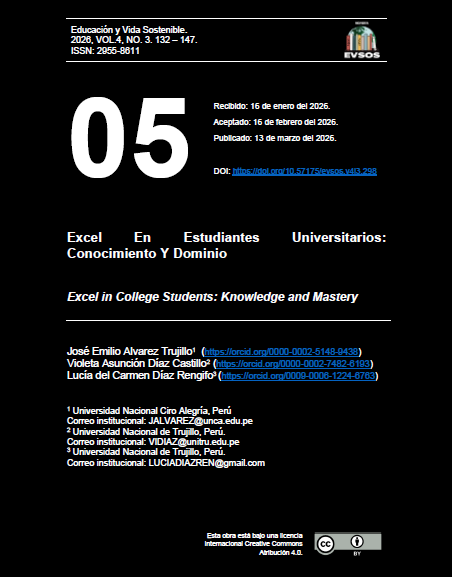
Excel in College Students: Knowledge and Mastery
DOI:
https://doi.org/10.57175/evsos.v4i3.298Keywords:
skills, digital, ExcelAbstract
The present study aimed to determine the level of theoretical knowledge and practical mastery of the Microsoft Excel program in university students at the National University of Trujillo, 2025. A quantitative, descriptive-correlational methodology was applied. The sample consisted of 65 students. A validated dichotomous questionnaire was administered, consisting of 20 items (10 on theoretical knowledge and 10 on practical mastery). The statistical analysis included measures of central tendency and the Chi-square test to establish associations between variables. The results showed that only 27.4% of respondents reported familiarity with Excel, compared to 47.6% who indicated no knowledge. Regarding practical mastery, 34.2% reported advanced skills, while 40.8% recognized limitations. The inferential analysis revealed a significant association (χ² = 18.65, p < 0.05), demonstrating a notable gap between theoretical knowledge (274 affirmative responses) and practical proficiency (342 affirmative responses). It is concluded that there is no significant relationship between proficiency and theoretical understanding, which is consistent with previous research on digital literacy. This phenomenon highlights the need to implement integrated pedagogical strategies that promote a balance between theory and practice, especially in university contexts with limited resources. The results of this research can serve as a starting point for redesigning digital skills training programs in higher education. Strengthening technological literacy from a theoretical-practical approach will close gaps and better prepare students for today's work environment.
Downloads
Metrics
References
(Cabero & Llorente, 2010; Morales & García, 2021).
Published
How to Cite
Issue
Section
License
Copyright (c) 2026 JOSE EMILIO ALVAREZ TRUJILLO, Violeta Asunción Díaz Castillo , Lucía del Carmen Díaz Rengifo

This work is licensed under a Creative Commons Attribution 4.0 International License.